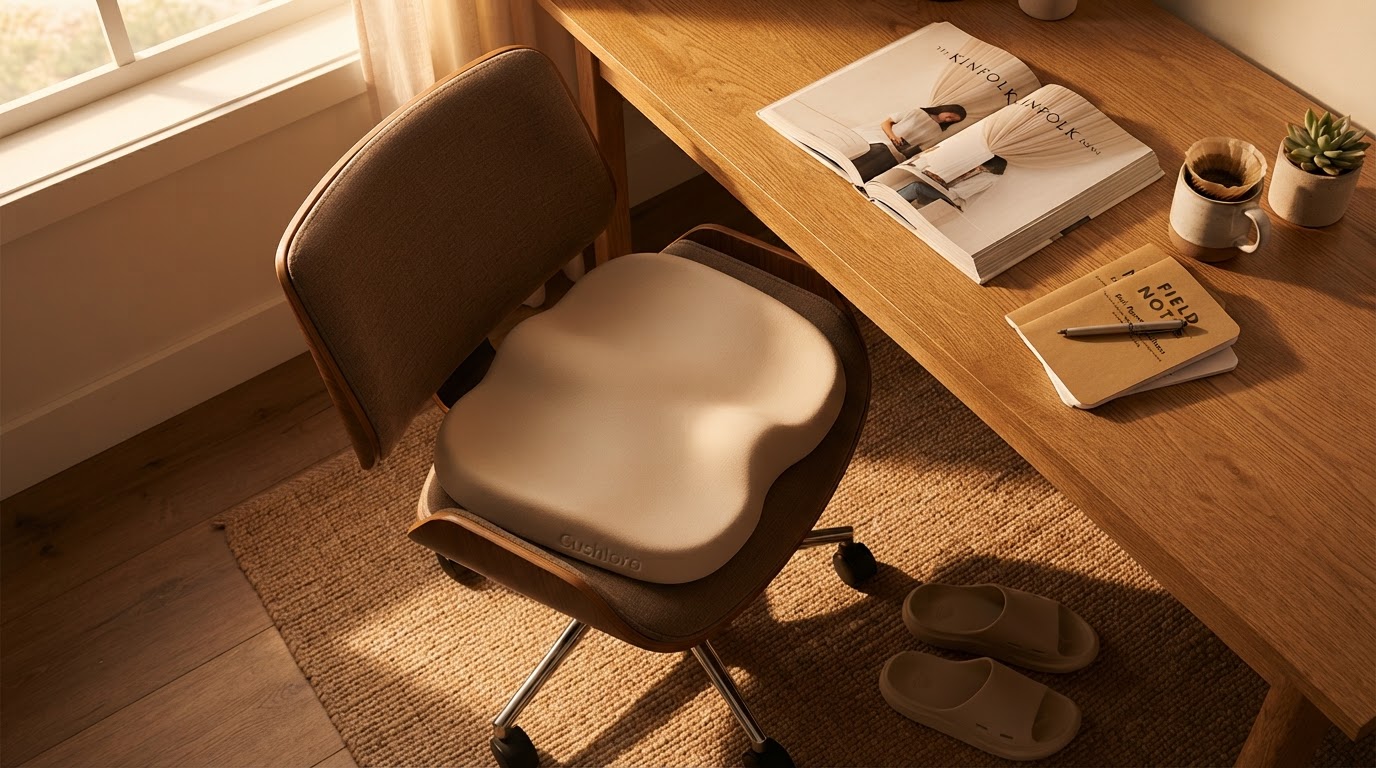
Improving Posture with the Cushlora Orthopedic Pad
 Daniel OkaforField Tester
August 16, 2026. This field report examines the practical impact of using the Cushlora orthopedic memory foam chair pad for extended sedentary work. It is intended for office professionals and remote workers seeking to mitigate the physical strain of long-duration sitting.
The Physical Cost of Prolonged Sitting
I spent the last month evaluating how traditional office chairs fail the lumbar spine during eight-hour shifts. Most standard seating lacks the nuanced contouring required to distribute weight away from the coccyx, leading to a phenomenon I call 'the afternoon slump' where the pelvis tilts forward and the lower back rounds. According to Art3d, specialized orthopedic cushions are often designed with a U-shape cut out specifically to relieve pressure on the lower back, sciatica, and herniated discs. I tested this for thirty days straight to see if the theory held up in a real-world home office environment. Day three is where I noticed the most significant shift in my sitting habits. Instead of constantly shifting my weight to find a comfortable spot, the memory foam provided a consistent baseline that prevented the typical hotspots on my sit-bones. The issue with most chairs isn't necessarily a lack of padding, but a lack of intentional density. When you sit on a standard foam cushion, it compresses to a flat state within an hour, leaving you effectively sitting on the hard plastic or wood frame of the chair. This compression is exactly what leads to the chronic discomfort many of us feel by 3:00 PM. Understanding the benefits of high-density memory foam is essential here, as the material must be firm enough to resist bottoming out while remaining soft enough to contour to the body's unique shape. Without that structural integrity, an orthopedic pad is just a decorative pillow.
Performance of the Cushlora System
Photo by Designecologist on Pexels
What surprised me during the second week of testing was how the Cushlora pad maintained its loft despite my 190-pound frame. I utilized the pad on three different surfaces: a mesh office chair, a wooden dining chair, and a car seat during a four-hour drive. The U-shaped cutout is the functional heart of the design, ensuring the tailbone remains suspended rather than compressed against the seat. This design philosophy aligns with observations from Vive Health, which notes that memory foam cushions offer steady, body-conforming support that makes them particularly effective for all-day office use. During my testing, the cushion acted as a corrective tool for my pelvis. Because the foam is responsive to heat and pressure, it created a personalized cradle that encouraged a more upright spinal alignment without me having to consciously think about it. Here's the moment it earned its place: I realized I hadn't stood up to stretch out a 'pinched' nerve in my right hip for four hours. The stability provided by the high-density core meant I wasn't wobbling or tilting, which is a common issue with cheaper, air-filled alternatives. However, keeping the equipment in top shape is a requirement for long-term use. I found that cleaning your orthopedic memory foam pad regularly is vital to prevent the outer fabric from losing its grip on the chair surface. If I were to do one thing differently, I would have started using the pad on my commute much sooner, as the vibration dampening in the car was an unexpected benefit that reduced my lower back fatigue before I even started my workday. The integration of high-density memory foam ensures that the support doesn't vanish after the first month of heavy use, which is where I've seen other pads fail in the past.
Selecting the Right Support Framework
Choosing an orthopedic pad requires looking past the initial softness and evaluating the structural geometry of the product. Based on my time with the Cushlora, there are specific markers of quality that dictate whether a cushion will actually improve your posture or just provide a temporary distraction from pain. You have to consider the environment where you spend the most time sitting. For instance, Alex Orthopedic highlights that seat cushion collections often include specialized designs like coccyx or donut cushions to meet various medical and ergonomic needs. When you are integrating a new pad into your routine, you should also be mindful of cleaning your orthopedic memory foam pad to ensure the hygiene of your workspace remains high. The following framework represents what I look for when determining if a cushion is worth the investment:
- Density Consistency: The foam should not collapse entirely under your full weight; it must provide a resistive lift.
- Anatomical Cutouts: A dedicated space for the coccyx is non-negotiable for relieving spinal pressure.
- Non-Slip Base: The pad must stay anchored to the chair to prevent you from sliding into a slumped position.
- Breathability: The outer cover should allow for airflow to prevent heat buildup during long sessions.
- Portability: It should be light enough to move between your office, car, and home without hassle.
Sources
Photo by Max Vakhtbovych on Pexels
- Gray Premium Orthopedic Memory Foam Seat Cushion Coccyx ...
- Orthopedic Seat Cushions for Back Pain & Ergonomic Chair Support
- Seat Cushions | Wedge, Elevated, Coccyx, Donut & More